Showing posts with label jataka. Show all posts

13. The Jackal and the Crow


A crow perched high in a tree, eating some delicious fruit.
A jackal decided to flatter the crow, hoping she would drop the fruit so that he could catch it.
“Fair lady, you look like a peacock up there!” he said to the crow. "Your feathers are dazzling. I've never seen anyone as beautiful and as graceful as you!"
The crow then flattered the jackal in return. “Kind sir, you look like a handsome young tiger!” she said, and as she spoke, all the fruit fell out of her mouth.
The jackal then grabbed the fruit and ran away, laughing.

Inspired by: The Jataka, translated by W.H.D. Rouse.
Notes: This is the Jambu-Khadaka Jataka. You can find a collection of different versions of this tale here: The Fox and the Crow. You can read more about jambu fruit, also known as water-apples, at Wikipedia.

Here is an illustration from a Kalila-wa-Dimna manuscript:


15. The Jackal and the Otters


There were once two otters who caught a fish, and then they quarreled about how to divide it.
“The middle is mine," one otter said. "You can have the head and the tail."
“No!” said the other otter. “I want the middle! I'll give you the head and the tail.”
A greedy jackal came by. "I'll be glad to judge between you," he said.
The otters explained what had happened.
"Oh, that's easy!" the jackal exclaimed. "You take the head... and you take the tail..." and then the jackal ran away with the middle part of the fish for himself.

Inspired by: The Jataka, translated by H.T. Francis and R.A. Neil.
Notes: This is the Dabbhapuppha Jataka. For another story about an opportunistic third party, see: The Hawks and the Crows, and for an untrustworthy judge, see: The Partridge and the Rabbit.


And here is an illustration of the story by Ellsworth Young:


24. The Boastful Beetle


There was once a tiny beetle who one day wandered into a place where people had enjoyed a wild party the night before.
Seeing a puddle of liquor on the ground, the beetle started drinking, and soon he was drunk.
"I am so mighty," he yelled, "that the world cannot bear my weight!"
An elephant wandered by.
"I'm going to fight you, elephant!" the beetle boasted. "We'll see who is the most mighty!"
The elephant laughed as he pooped and peed on top of the beetle, killing the insect instantly.
The elephant then ran into the forest, trumpeting in triumph.

Inspired by: The Jataka, translated by W.H.D. Rouse.
Notes: The Gutha-Pana Jataka.


27. The Monkey and the Peas


A monkey high up in a tree saw some peas lying nearby on the ground.
He jumped down and gathered all the peas in his hands, and then went back up the tree to enjoy his feast.
"Delicious!" he said.
As he was eating, one of the peas fell out of his hand.
"Oh no!" he shouted.
He jumped down to grab the lost pea, and as he did, all the other peas fell out of his hands.
Hearing his shout, more monkeys came and started eating.
Because he couldn’t let one pea go, the monkey lost all the rest.

Inspired by: The Jataka translated by W.H.D. Rouse.
Notes: This is the Kalaya-Mutthi Jataka. In the context of the story, a king witnesses these actual events and learns a lesson from the monkey.

Here is an illustration by Ellsworth Young:


28. The Crocodile and the Monkey


Craving Monkey's heart for supper, Crocodile swam to the riverbank where Monkey lived.
"Let's go to Banana Island, Monkey!"
"But you know I can't swim."
"Don't worry! I'll carry you."
Greedy for bananas, Monkey jumped on.
Crocodile plunged deep under the water.
"What are you doing?" Monkey shrieked.
"I'm going to eat your heart for supper."
"But I left my heart in the tree!"
Monkey pointed to the fig tree on the riverbank.
"Well, go get it!" shouted Crocodile.
Crocodile swam back to shore, and Monkey leaped into the tree.
"You might fool me once," he cackled. "But only once!"

Inspired by: The Jataka translated by W.H.D. Rouse.
Notes: For other examples of this international folktale type, see Dan Ashliman's website: The Monkey's Heart.

Here is an illustration by W. Robinson:


29. The Monkey and the Rock


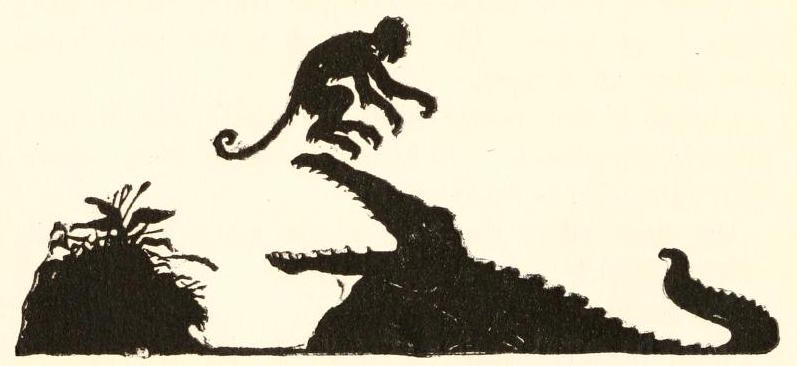
Crocodile noticed Monkey using a rock to cross the river, jumping from riverbank to rock, and then from rock to riverbank.
"I'll make my back look like a rock," thought Crocodile. "He'll jump on me, and I'll catch him!"
Monkey saw a suspicious new rock in the river, so before he jumped, Monkey said, "Hello, Rock!'
Crocodile said nothing.
Monkey shouted, "Hey, Rock! Why don't you answer me like you usually do?"
Crocodile realized he had to answer. "Hello, Monkey…" he said cautiously.
"Hello to you, Crocodile," Monkey cackled. "And goodbye! I won't be jumping on you today… or ever!"

Inspired by: The Jataka translated by Robert Chalmers
Notes: Compare the story of Brer Rabbit in Heyo House.

Here is an illustration by Ellsworth Young; it shows the second part of the story, which I have not included, where the monkey tricks the crocodile into closing his eyes so that the monkey can indeed jump over to the other side.


42. The Crane and the Fish


The lake was drying up.
"Don’t worry, fish-friends!" said a crane. "I'll carry you to my home, a big lake nearby."
"Thank you!' said the fish, and she carried them off one by one.
But the crane wasn't relocating the fish; she was devouring them.
Finally only a crab remained.
"Come on!" said the crane.
Then, as they were landing, the crab looked down and saw fishbones, so he grabbed the crane's neck with his pincers.
"Let go!" the crane said, but the crab squeezed.
SNAP!
The crane died, and the crab lived happily ever after in the big lake.

Inspired by: The Jataka, translated by Robert Chalmers.
Notes: This is a Baka Jataka. This story is also found in the Panchatantra and derived texts (where it is part of Book 1, Story 9). The story is also included in Raju's Indian Fables. For another Baka Jataka, see the story of the fish and the sleeping crane. Here is an illustration by Ellsworth Young:


Here is an illustration by E. Boyd Smith:


51. The Rabbit and the Coconut


Rabbit slept under a coconut-tree, and a coconut fell on his head.
"The sky's falling!" Rabbit shouted. He jumped and ran.
"What's wrong?" Deer asked.
"End of the world! The sky's falling!" shrieked Rabbit, and Deer ran with him.
They met Fox. "What's wrong?" she asked.
Rabbit panted, "Sky falling! End of world!"
Now Rabbit, Deer, and Fox were running.
Monkey, Leopard, Elephant... all running!
Lion stopped them. "Who says it's the end of the world?"
They pointed at Rabbit, and Rabbit took Lion to the tree.
"A coconut fell down!" Lion roared. "It's not the end of the world."

Inspired by: The Jataka translated by H.T. Francis and R.A. Neil.
Notes: You can find many examples of this type of folktale at Dan Ashliman's website: The Sky is Falling.

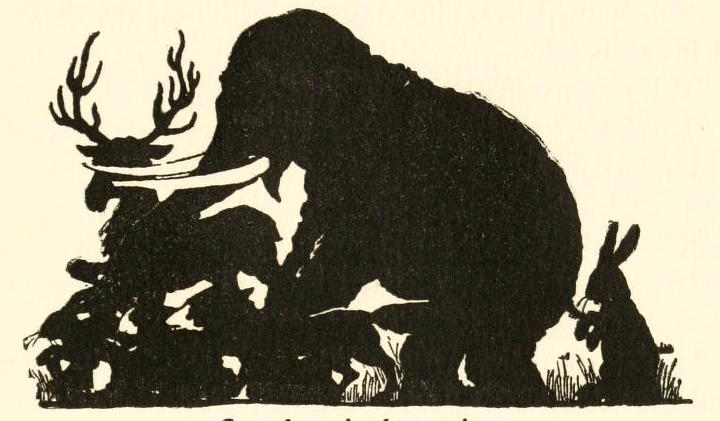
Here is an illustration by Ellsworth Young:


59. The Monkeys and the Gardener


The royal gardener wanted a vacation.
There were some monkeys living in the garden, so the gardener decided to put the monkeys in charge while he was gone.
“Make sure you water all the plants!” he told the monkeys.
“We should inspect the roots first," commanded the chief of the monkeys. "The deep roots need lots of water; the shallow roots not so much.”
So the monkeys inspected the roots carefully, pulling them up out of the ground to look at them.
The gardener came back from vacation to find all the plants were dead, uprooted by the foolish monkeys.

Inspired by: The Jataka, translated by Robert Chalmers.
Notes: This is the Aramadusaka Jataka. Here is an illustration by Ellsworth Young:


72. The Turtle in the Lake


The princes shouted, "Father, we saw a terrible lake-monster!"
The king's guards went and caught the monster.
It was only a turtle, but the princes had never seen a turtle before and it frightened them.
"How shall we kill it?" the king asked.
"Crush it!" said the first prince.
"Burn it!" said the second.
"Drown it!" said the third.
Then the turtle shrieked, "Don't drown me! Crush me, burn me, but please don't drown me!"
"Drown the turtle!" the king commanded.
The guards threw the turtle into the lake.
The turtle shouted "Home at last!" as he happily swam away.

Inspired by: The Jataka, translated by E. B. Cowell and W. H. D. Rouse.
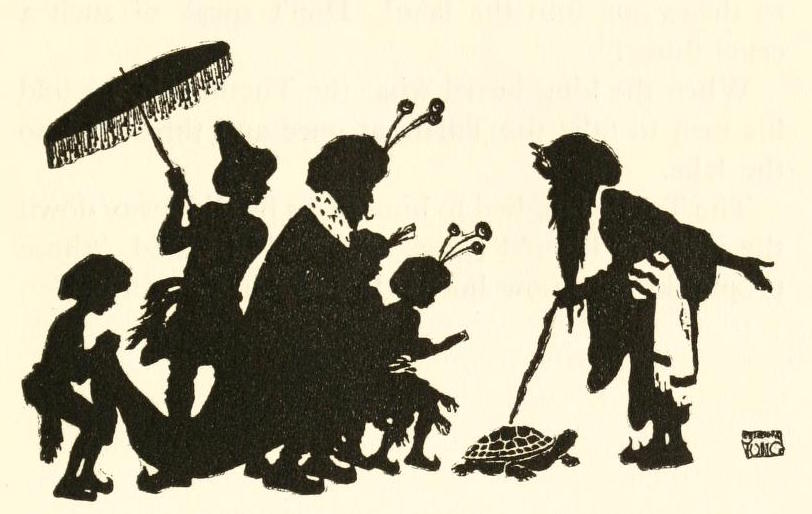
Notes: The story of the turtle who tricks the people into throwing him back into the lake (much like Brer Rabbit getting thrown back into his briar patch!) is only part of a much longer story. Here is an illustration by Ellsworth Young:


73. The Turtle and the Two Birds


A turtle once befriended two birds, and the three friends lived together at a lake.
The lake was drying up, so the birds offered to carry the turtle away.
“You bite the middle of this stick, and we'll carry the ends in our beaks," they said. "But you must keep your mouth closed. Don't open your mouth, okay?”
“Okay!” the turtle said.
They soared into the sky: the plan worked!
But then people on the ground started laughing.
"That turtle looks ridiculous up there!" they said.
The turtle opened his mouth to rebuke them and thus plunged to his death.

Inspired by: The Jataka, translated by W.H.D. Rouse.
Notes: The Kacchapa Jataka. There is a Wikipedia article about the spread of this story from India to other traditions, and there is a collection of versions here: The Tortoise That Wanted to Fly. There is a version in the Panchatantra also, Book 1, Story 19.

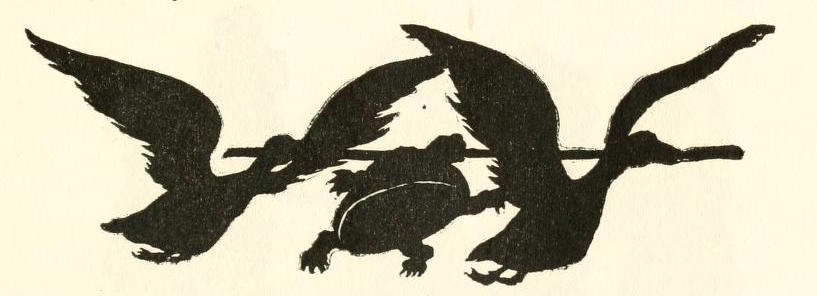
Here is an illustration by Ellsworth Young:


Here is an illustration by E. Boyd Smith:


81. The Rats and the Jackal


The Buddha was born as a rat, and there was a jackal who liked to eat rats.
To trick them, the jackal pretended to be a sadhu, gazing at the sun, standing on one leg, eating no food.
Each day the rats would run by the saintly jackal, and each day the jackal grabbed the last rat running by.
The Buddha suspected something was wrong, so he brought up the rear.
When the jackal tried to grab him, the Buddha shouted, “You evil hypocrite!” He jumped at the jackal’s throat and killed him, and the rats enjoyed a great feast.

Inspired by: The Jataka, translated by Robert Chalmers.
Notes: This is the Bilara Jataka. Here is an illustration by Ellsworth Young (for a version of the story with a wolf instead of a jackal)?


82. The Jackal in the Elephant


In another lifetime, the Buddha was again born as a jackal.
One day, this jackal found an elephant carcass.
“Food!” he shouted happily.
He gnawed the elephant's trunk; not much meat there.
The tusk was like bone.
The ear was tough.
The feet were hard as rocks.
Then the jackal crawled inside where the meat was soft to eat. He stayed in there for days.
Meanwhile, the summer heat made the carcass shrink.
The jackal couldn't get out. He was trapped!
Finally it rained.
As the carcass expanded again, he escaped.
“I'll never be so greedy again!” the Buddha vowed.

Inspired by: The Jataka, translated by Robert Chalmers.
Notes: This is a Sigala Jataka. For another Sigala Jataka, see the story of the jackal and the would-be corpse.


83. The Jackal and the Corpse


The Buddha was again born as a jackal, and he made his home in the cremation fields amidst the corpses.
A wicked man who wanted to kill the jackal had gone there and lay on the ground, club in hand, pretending to be dead.
The jackal approached, but he suspected this man was not really dead.
He grabbed the club in his teeth and tugged. The man tightened his grip, and the jackal let go.
“Human, if you were dead, you wouldn’t have tightened your grip.”
The man then sprang up, but he was too late: the Buddha had escaped.

Inspired by: The Jataka, translated by Robert Chalmers.
Notes: This is a Sigala Jataka. The cremation grounds are called smashana in Sanskrit. You can find out more at Wikipedia. For another Sigala Jataka, see the story of the jackal inside the elephant.


84. The Jackal and the Lion


The Buddha was once born as a lion.
A jackal asked to be this lion's servant. The lion agreed, and the jackal grew fat eating food the lion killed.
As time went by, the jackal thought he was as strong and mighty as a lion. “I'm ready to kill an elephant on my own!” he boasted.
The lion warned him of the danger, but the jackal wouldn’t listen.
Then, when the jackal tried to bite an elephant’s foot, the elephant crushed the jackal to death.
“Foolish jackal,” said the Buddha, “you learned your limitations at the cost of your life.”

Inspired by: The Jataka, translated by Robert Chalmers.
Notes: This is the Virocana Jataka. Here is an illustration by Ellsworth Young (for a version of the story with a wolf instead of a jackal):


85. The Deer and his Nephew


The Buddha was born as a deer.
The deer's sister said to her son, "Go to your uncle and learn the tricks you need to stay safe from hunters."
But the young deer didn't listen to his mother.
The Buddha said to him, "Nephew, there are things you must learn to stay safe. I will teach you."
But the young deer didn't listen to his uncle.
He then fell into a hunter's trap and was killed.
"Brother," said the Buddha's sister, weeping, "why didn't you teach him?"
"I couldn't teach him," said the Buddha, "because he didn't want to learn."

Inspired by: The Jataka translated by Robert Chalmers
Notes: This is the Kharadiya-Jataka.


86. The Two Oxen


The Buddha was born as an ox. His name was Big Red, and he had a brother named Little Red.
They lived on a farm together with other animals, including a pig.
The oxen worked hard, but the pig didn't work; the pig just ate.
And ate.
And ate.
Little Red was jealous, but Big Red told him, "That pig is eating the food of death; they are fattening him up for a wedding."
Big Red was right: when the wedding day came, that was the end of the pig, and Little Red recognized the wisdom of the Buddha's words.

Inspired by: The Jataka, translated by Robert Chalmers.
Notes: This is the Munika Jataka. Here is an illustration by Ellsworth Young:


87. The Fish and the Crane


The Buddha was once born as a fish, and through his good actions he became the king of the fish.
There was a crane who wanted to eat the fish, so he pretended to be asleep. The other fish were fooled, but the Buddha realized that the crane was their deadly enemy.
"My fellow fish," the Buddha said, "we must drive this wicked creature away, and it will take all of us working together. One, two, three... SPLASH."
At the Buddha's command, the fish all started splashing at the crane until he finally flew away to look for food elsewhere.

Inspired by: The Jataka, translated by W.H.D. Rouse.
Notes: This is a Baka Jataka. Compare the Baka Jataka about the crane, the fish, and the crab.


88. The Parrot and the Mangos


The Buddha was born as a parrot. He had a son. When he grew up, the son cared for his elderly father, bringing him food.
One day the son flew to an island full of mango trees. He brought back a mango.
"Beware, my son," said the parrot’s father. "That is too far; do not go to the mango island."
But the son did not listen. He flew again to the mango island, and then he grew so tired flying home that he fell into the ocean, and a fish ate him.
The Buddha waited, but his son never returned.

Inspired byThe Jataka, translated by W.H.D. Rouse.
Notes: This is the Suka Jataka.


89. The Woodpecker and the Lion


The Buddha was once born as a woodpecker.
One day this woodpecker saw a lion, groaning in pain.
“Help me, woodpecker!" shouted the lion. "Extract the bone stuck in my throat, and I’ll give you a reward!”
The woodpecker agreed, but he was cautious.
First, he propped the lion’s mouth open with a stick, and only then did he extract the bone.
After emerging from the lion’s mouth, he knocked away the stick.
“What’s my reward?” the woodpecker asked.
“Escaping my teeth is reward enough!” the lion snarled.
Thus the Buddha knew he was wise not to trust the lion.

Inspired by: The Jataka, translated by H.T. Francis and R.A. Neil.
Notes: This is the Javasakuna Jataka. You can find other versions of the story here: The Wolf and the Crane. Here is an illustration by Ellsworth Young: